Skip to content

Hearing, speech & sight

Built first for the people other systems fail.

Getting it right for someone hard of hearing, someone whose speech is slurred and someone who can't read the post makes it right for everyone else too. These aren't settings. They're how it works.

Rosa, 79, on a rattan sofa in Manila, pressing a landline phone to her ear and leaning in to listen.

Hearing

Telephones already strip out the high frequencies, and those are the ones hearing loss takes first. So the voice has to do the work.

  • Speaks lower, slower and at an even loudness.
  • When she misses something, it says it again in different words, slower — never the same sentence replayed.
  • Keeps adjusting through the call as it notices what she's missing.
  • Never accepts a bare “yes” for anything that matters. It asks her to say it back.
  • Carries warmth in the words, not the tone, because tone doesn't survive a phone line.

Hear Rosa’s call
Ravi, 73, on a shaded veranda in Chennai, holding a landline handset, with a crossword on the armrest.

Speech

After a stroke, or with Parkinson's, people often know exactly what they want to say and it comes out wrong. Most voice systems fail them outright.

  • Never says “sorry, can you repeat that”. It offers its best two or three guesses and lets him choose.
  • Confirming takes a word, a hum or a keypress — much less effort than saying it again.
  • Never acts on a guess. Nothing is ordered, sent or said on his behalf until he confirms.
  • Learns his speech over time and keeps a phrasebook of the things he says often.
  • Can speak for him, to a pharmacist or a grandchild, in words he approved.
  • Honest about the start: the first week is noticeably harder than later ones, and we say so before anyone begins.
Hear Ravi’s call
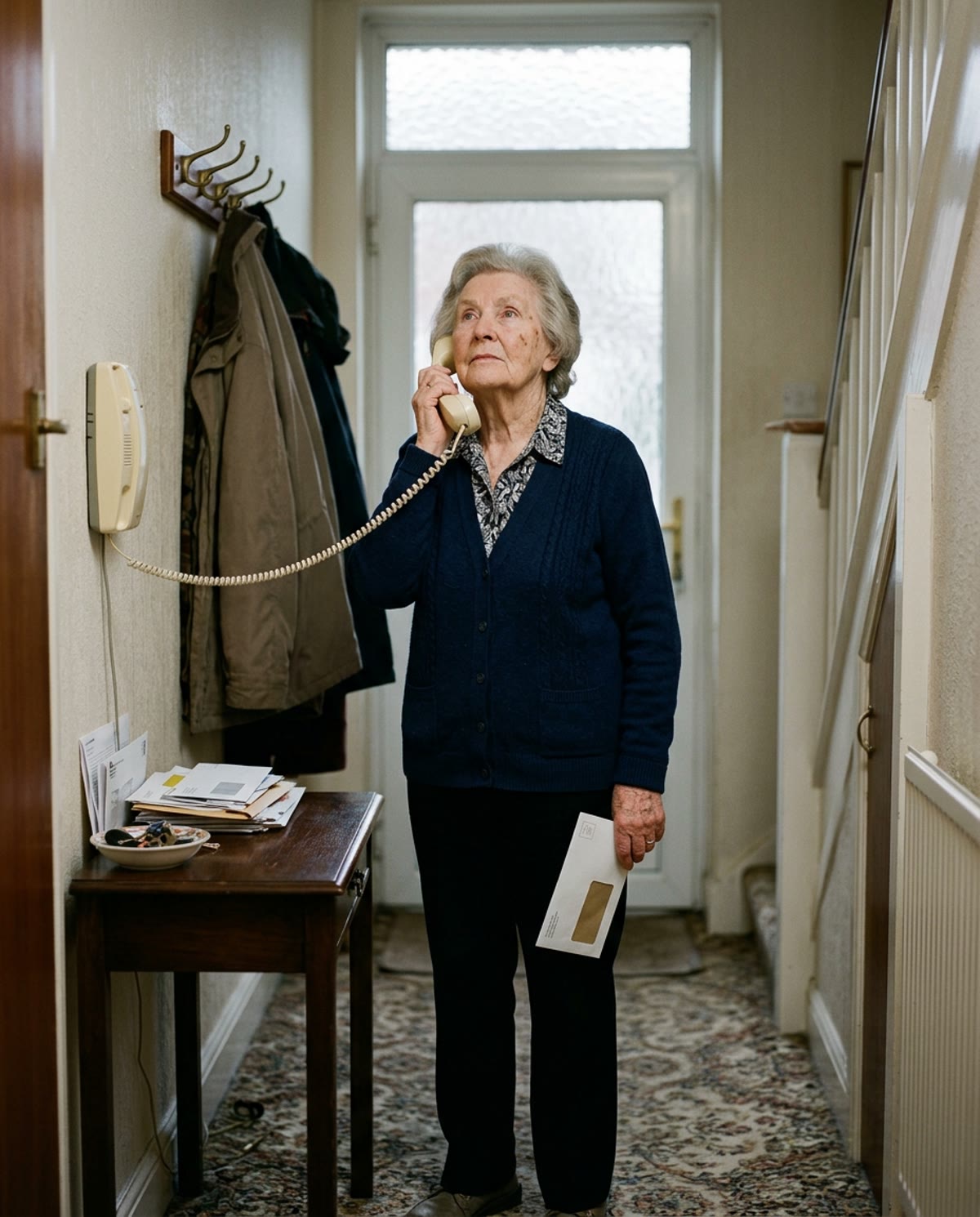
Florence, 83, in the hallway of her Manchester terraced house, holding a hospital letter and a corded phone.

Sight

A telephone is the one thing that works better, not worse, when you can't see well. Every tablet and screen-based product is unusable to her.

  • Letters read aloud word for word, in order, with the sender and date.
  • Stops when she says stop. Re-reads any part, slower. Never speeds up through the dull bits.
  • Never summarises and never tells her what it means. She hasn't lost her judgement.
  • If it can't make out a detail, it says so rather than guessing.
  • Money, legal and medical letters are also passed to family, so nobody is left alone with them.
Hear Florence’s call

Memory

It notices difficulty quietly, and never makes it a test.

Word games and quizzes are there if she enjoys them, never framed as an assessment, and she can turn them off by saying so. If something gets harder, the difficulty changes without comment. No score is shown to anyone.

We make no claim that it slows or prevents dementia. It isn’t a diagnostic tool, and it will never tell her family she’s declining. It tells them what she said, and when something has changed.

Too far away? Not from their phone.